Hanna is sentenced to life imprisonment
The ReaderHanna’s life sentence is the decisive outcome of the camp trial and the beginning of an eighteen-year imprisonment. Read aloud over several hours before a crowded courtroom, the verdict punishes her individually while leaving unresolved the broader questions of legal responsibility and postwar German memory that had shaped the trial from the start.
The verdict and its public setting
The verdict was handed down at the end of June. Hanna was sentenced to life; the other defendants received prison terms. The courtroom was packed with people from the justice system, university students, schoolchildren, journalists from Germany and abroad, and habitual courtroom spectators. As the defendants entered, a ripple of whispered attention spread through the room until the crowd fell silent.
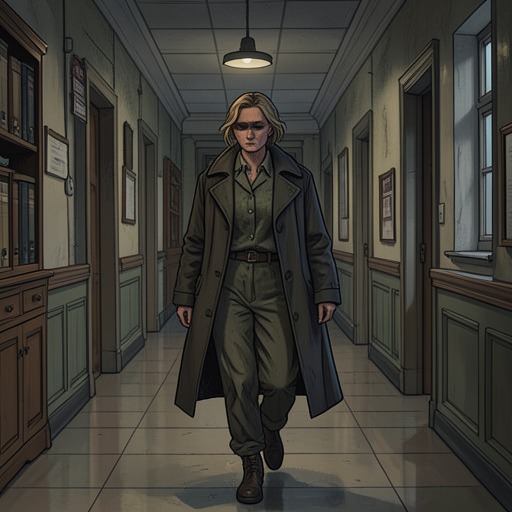
Hanna wore a black suit and white blouse, with a cut and tie that made her look, to the narrator and the spectators, as if she were in uniform. The narrator had never seen the uniform worn by female SS guards, yet those present believed they were seeing both that uniform and the woman who had served in the SS. Her appearance seemed to gather the crimes for which she was accused into a single image. Many spectators took it as ridicule of the trial and its verdict; some called out their outrage before the court entered.
The reading of the sentence
When the judge announced the verdict, Hanna stood straight-backed and completely still. She sat while the reasons for the decision were read. The reading lasted several hours, and the narrator kept his eyes on her head and neck, watching her rather than the proceedings around her.
After the trial ended, the defendants were led away. The narrator waited in his usual seat to see whether Hanna would look at him, but she stared ahead, seemingly through the room and its people. He describes her expression as proud, wounded, lost, and infinitely tired: a look that wished to see no one and nothing. The sentence is thus presented both as a formal legal outcome and as a moment of separation between Hanna and the man who had loved her.
Imprisonment and clemency
Hanna’s sentence meant eighteen years in prison. In the eighth year of her imprisonment, the narrator began sending her recorded readings; he continued until the eighteenth year. Their contact remained word-driven and largely impersonal, until Hanna sent him a short note thanking him for a story. The note revealed that she had learned to write. The narrator understood this as a movement from dependence toward independence, though he also felt the pain of how late that change had come.
In the eighteenth year, Hanna’s plea for clemency was granted, and her release was expected shortly afterward. The prison warden wrote to the narrator because his correspondence was Hanna’s only contact with the outside world. Although Hanna was in excellent health and had developed skill in the prison sewing shop, the warden warned that returning to ordinary life after so long inside could leave her lonely and helpless. She urged him to visit Hanna before release and help arrange an apartment, work, and support in the first weeks outside.
Legal judgment and historical responsibility
The trial had raised a question that the sentence could not settle by itself: whether justice depended only on laws already written when crimes were committed, or also on how laws were interpreted and enforced at the time. In the seminar accompanying the trial, the students treated convictions of individual camp guards as only a beginning. They also placed under moral scrutiny the generation that had served perpetrators, failed to stop them, or tolerated them after 1945.
For the narrator’s generation, collective guilt was a lived moral reality, intensified by continuing signs of the Nazi past in public life. Yet assigning blame did not remove shame. The verdict therefore stands at two scales: it imposes a life sentence on Hanna, while the narrator’s account keeps open the larger question of how a society and its children reckon with crimes, complicity, and silence. The sentence is conclusive as a judicial decision, but it does not resolve that inheritance.